
AI in Travel and Hospitality: Use Cases, Systems and How to Start
AI in travel and hospitality for hotel and travel leaders: use cases by trip stage, a PMS checklist, build vs buy, real costs and PCI rules.
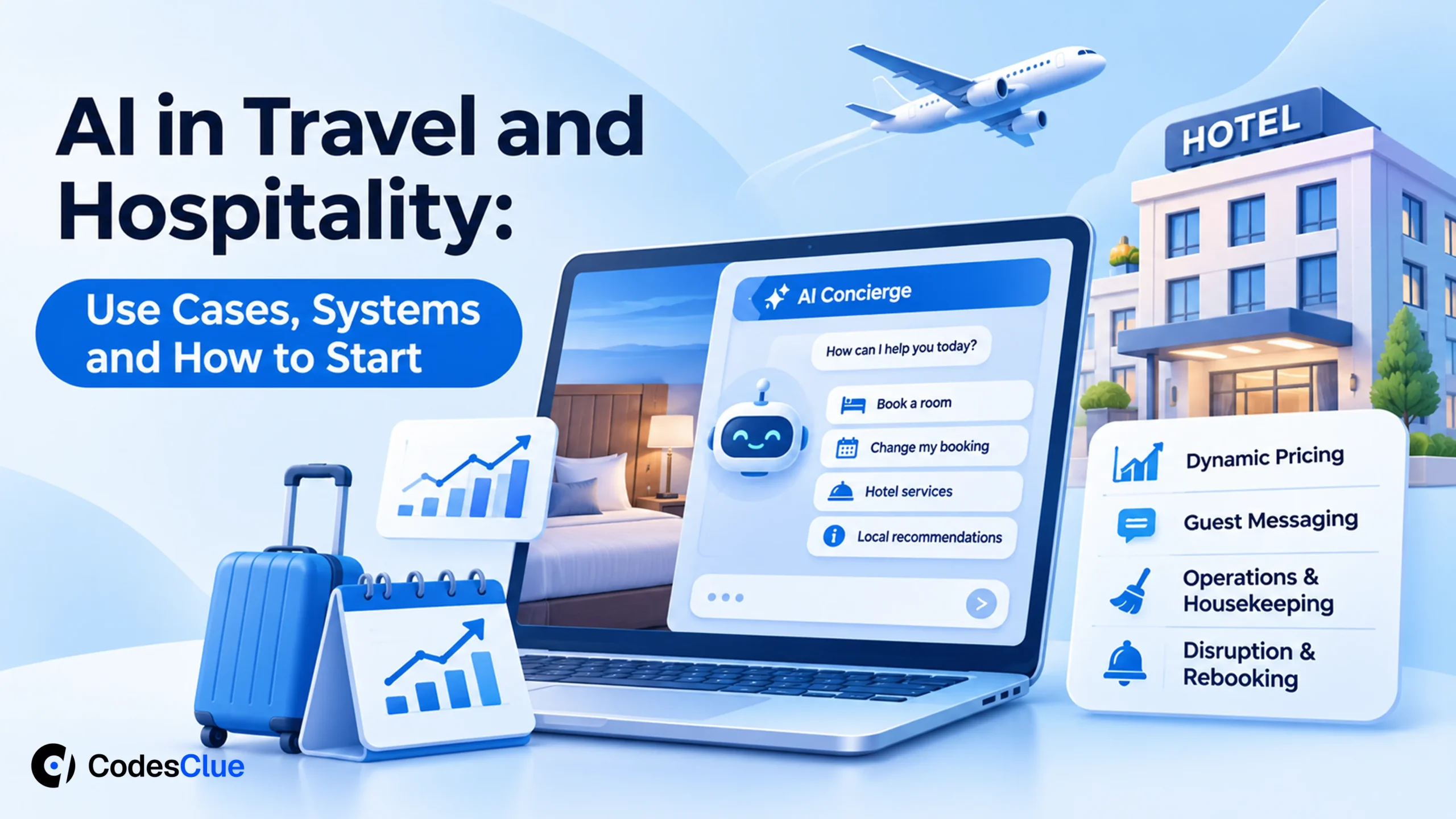
Your front desk answers the same ten guest questions all day. Your revenue manager still moves room rates by hand on Sunday night. Meanwhile, three vendors have pitched you an “AI concierge” this quarter, and none of them asked what systems you run.
This guide gives you a straight answer on AI in travel and hospitality. You will see which use cases pay off at each stage of a trip and which systems they need. We also cover build or buy, cost, privacy rules and how to prove results.
Key Takeaways
- AI helps most in three places: pricing, guest messages and the work behind the scenes, such as housekeeping plans and disruption handling.
- Your systems decide what is possible. A clean link between the PMS, booking engine and CRM matters more than the model you choose.
- Most hotels should buy or extend first and build custom only where it sets them apart from rivals.
- AI agents can book and rebook, but money, refunds and exceptions still need a person to approve them.
- Plan for EU AI Act chatbot notices, GDPR and PCI DSS before the first guest message goes out.
What does AI in travel and hospitality actually do?
AI in travel and hospitality uses guest, booking and operations data to predict demand, set prices, answer guests and plan staff work. It reads booking history, reviews, messages and live events, then suggests or takes the next step. Hotels, airlines, tour operators and online travel agencies use it to sell more rooms and seats with fewer manual tasks.
Most of it falls into three families. Predictive models forecast demand and cancellations. Generative AI writes replies and offers in the guest’s language. AI agents go further and act inside your booking tools.
Staff shortages make this urgent. An American Hotel & Lodging Association survey (opens in a new tab) released in February 2025 found that 65% of surveyed hotels still reported shortages. Housekeeping topped the list at 38% of hotels, followed by the front desk at 26%.
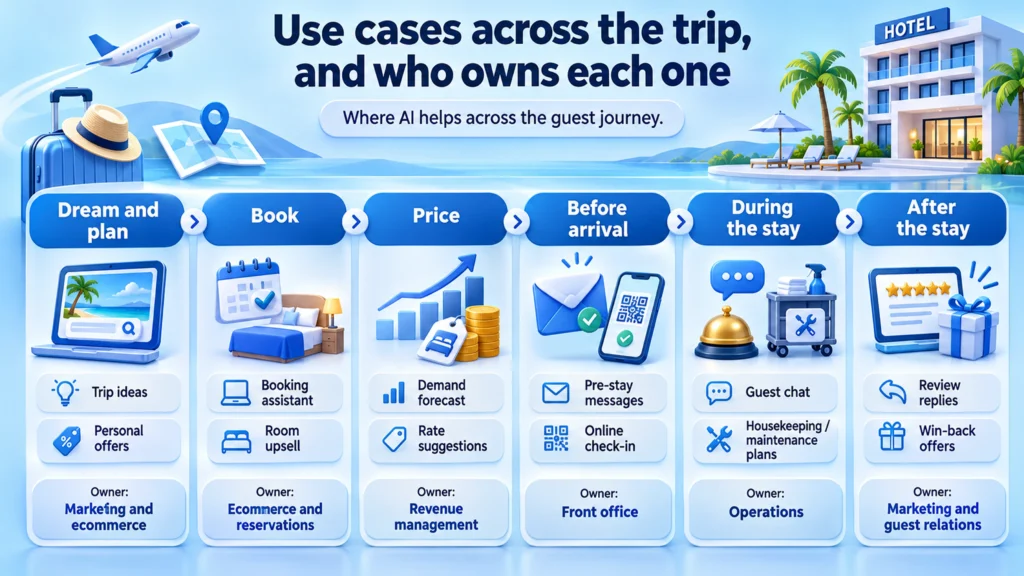
Use cases across the trip, and who owns each one
A use case only works when one team owns it. Match each idea with the people who will run it.
| Stage of the trip | AI use case | Team that owns it | Systems it touches |
|---|---|---|---|
| Dream and plan | Trip ideas, search in plain language, personal offers | Marketing and ecommerce | Website, CRM, content tools |
| Book | Booking assistant, upsell of room types and extras | Ecommerce and reservations | Booking engine, CRS, payment gateway |
| Price | Demand forecasts and rate suggestions | Revenue management | PMS, CRS, channel manager, rate shopper |
| Before arrival | Pre-stay messages, online check-in, ID and preference capture | Front office | PMS, messaging tool, CRM |
| During the stay | Guest chat in many languages, housekeeping and maintenance plans | Operations | PMS, task app, POS |
| Disruption | Rebooking after a delay or overbooking, proactive alerts | Reservations and customer care | CRS, GDS, airline or supplier feeds |
| After the stay | Review replies, win-back offers, loyalty insights | Marketing and guest relations | CRM, review platforms |
Hotel revenue management AI
Revenue tools forecast demand per night and room type, then suggest a rate. They watch pickup pace, local events, competitor prices and cancellations. Your revenue manager approves each change until the team trusts the numbers.
Ready-made tools such as IDeaS, Duetto and Atomize cover this well. Build custom only for what they model poorly, such as tours, packages or event space.
Generative AI in travel messaging
A language model drafts replies to guests by chat, email or WhatsApp. It works best when it answers from your own facts: room types, policies, opening hours and the live booking. Without that grounding, it will make up a late checkout you never offered.
Pro tip: Give the assistant a short “can say” list and a “must hand over” list. Refunds, complaints, accessibility needs and anything about money go straight to a person.
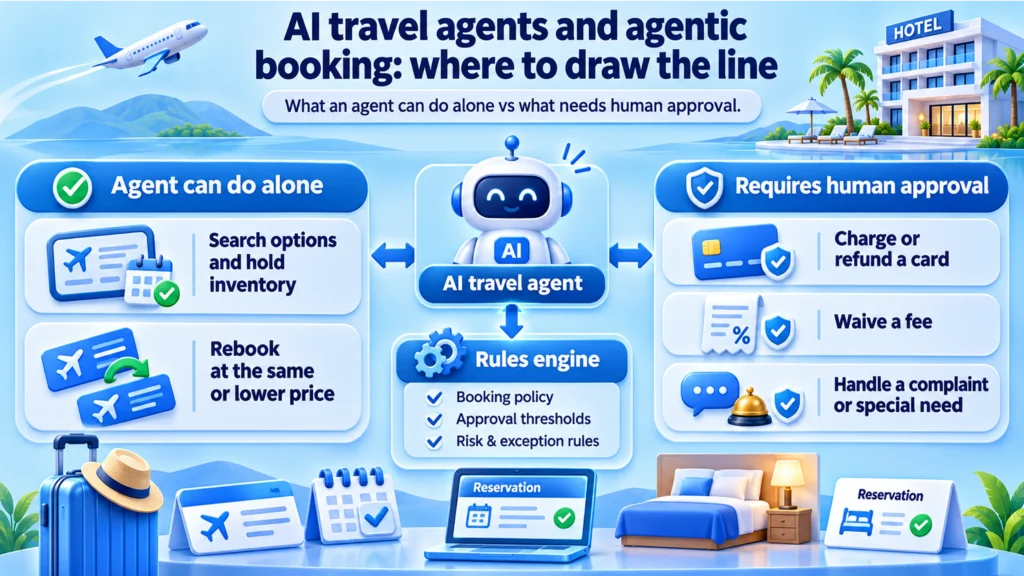
AI travel agents and agentic booking: where to draw the line
An AI travel agent does more than chat. It searches inventory, holds a room, changes a booking and sends the confirmation. That saves hours in a disruption, when hundreds of guests need a new plan. It also means a mistake costs real money, so set limits by risk.
| Action | Agent alone | Agent plus a person |
|---|---|---|
| Search options and hold inventory | Yes, with a time limit | No need |
| Rebook at the same or lower price | Yes, within set rules | Spot checks |
| Charge a card, refund or waive a fee | No | Yes, every time |
| Handle a complaint or special need | No | Yes, a person leads |
Rules apply here too. Under Article 50 of the EU AI Act (opens in a new tab), people must learn that they are talking to an AI system unless it is obvious. That duty has applied since 2 August 2026, so a European booking chat needs a clear notice in its first message.
Pro tip: Log every action an agent takes, with the booking reference and the rule that allowed it. When a guest disputes a change, your team can answer in minutes.
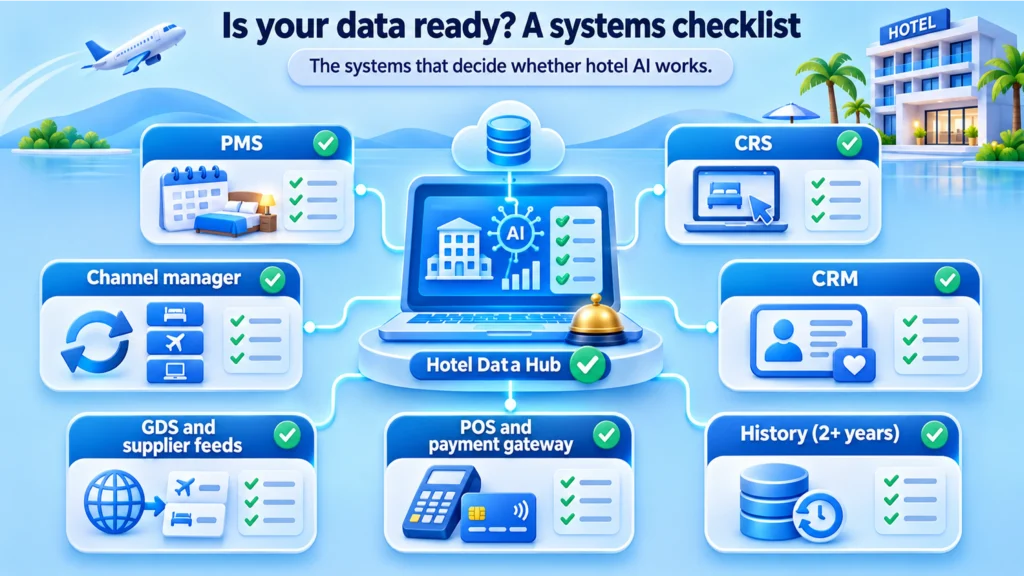
Is your data ready? A systems checklist
Most hotel AI projects stall on data, not on models. Work through this list with the owner of each system before you pick a tool.
- PMS (property management system). Does it offer an open API for reservations, room status and guest profiles? Can you read data in near real time?
- CRS (central reservation system). Do rates and availability match across all your properties, or does each hotel keep its own rules?
- Channel manager. Can you see which channel each booking came from, with its commission and cancellation date?
- CRM. Does one guest have one profile, or five copies with different email addresses?
- GDS and supplier feeds. If you sell flights, tours or transfers, do you have the right to store and reuse that data?
- POS and payment gateway. Do card details stay with the payment provider as tokens, away from your own systems?
- History. Do you hold at least two years of clean booking data, so the model sees a full season twice?
Not sure how your stack scores? Send us a list of your systems, and we will tell you which use case it can support first.
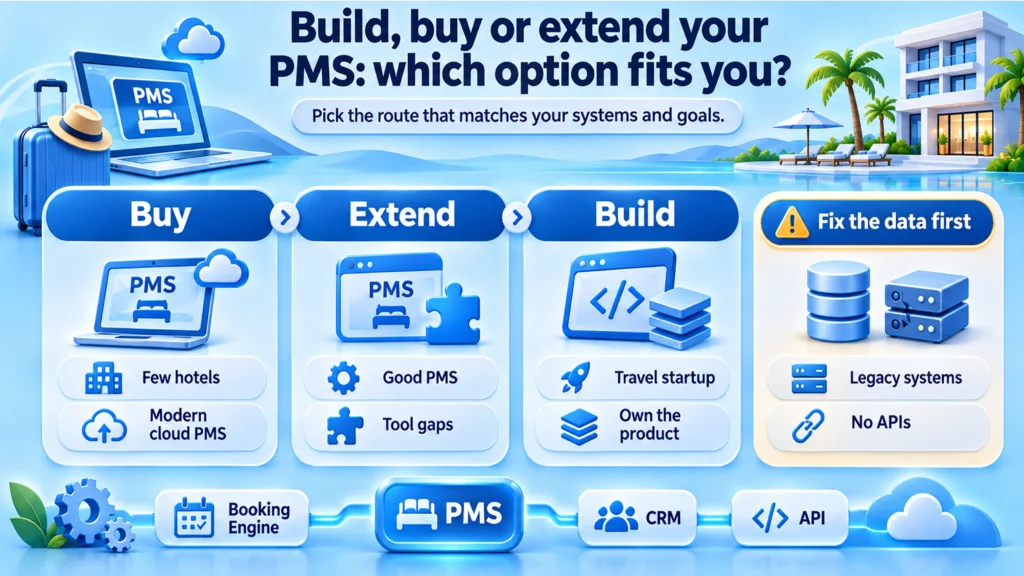
Build, buy or extend your PMS: which option fits you?
Most hotel groups mix three routes. Pick one per use case, not once for the whole company.
| Your situation | Best route | Why |
|---|---|---|
| One or a few hotels, standard rooms, a modern cloud PMS | Buy | Marketplace apps for pricing and messaging plug in within weeks |
| A group with a good PMS but gaps between tools | Extend | Custom AI integration joins the PMS, CRM and booking engine, so one model sees everything |
| A travel startup, tour operator or OTA with its own product | Build | The AI is the product, so you need to own the logic and the data |
| Many legacy systems with no APIs | Fix the data first | Any AI on top of broken links will give wrong answers with confidence |
When we would not use AI at all
- A small guesthouse with steady demand, where a simple rate calendar does the job.
- Luxury service where the human touch is what guests pay for. Use AI behind the scenes there, not in front of guests.
- Any case with less than a season of clean data. Fix the records first, then come back.
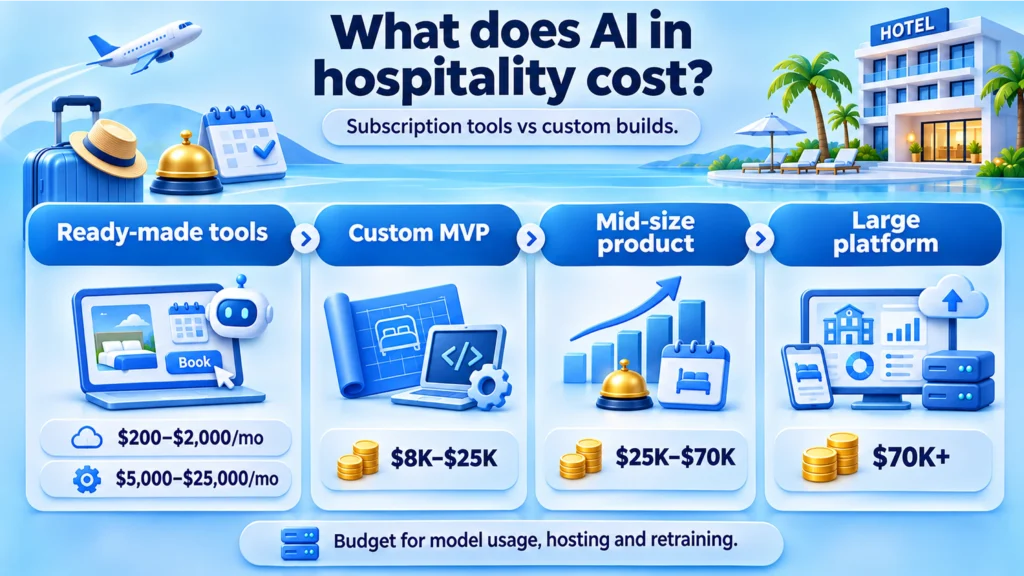
What does AI in hospitality cost?
Ready-made tools charge a subscription. RaftLabs, in its own guide, lists about $200 to $2,000 a month for small properties and $5,000 to $25,000 a month for mid-size operators. Ask each vendor for a quote per property.
For custom work, CodesClue prices in three bands. A focused MVP, for example a guest assistant grounded in your PMS data, usually lands between $8K and $25K. A mid-size product with several integrations sits at $25K to $70K. Larger platforms, such as a booking agent across many suppliers, start from $70K.
Our guides to AI app development cost and AI agent development cost break this down. Budget for model usage, hosting and retraining every year too.
Privacy and payment rules to plan for
Guest data includes names, passports, card details and sometimes health needs. Three rules shape most designs for US, UK and European buyers.
- Collect only what you need. The UK ICO guidance on data protection by default (opens in a new tab) says you should only use personal data your purpose needs. Your AI should not read passport scans to suggest a spa slot.
- Keep card codes out. The PCI Security Standards Council (opens in a new tab) forbids keeping card verification codes after authorisation, even for card-on-file use. So chat logs and AI prompts must never hold full card data.
- Tell guests about the AI. Add the AI Act notice in Europe and explain guest data use in your privacy policy.
Our HIPAA and PCI DSS compliance article goes deeper on card data controls.
Pro tip: Mask card numbers, passport numbers and phone numbers before any text reaches a language model. It costs a day of work and removes a whole class of risk.
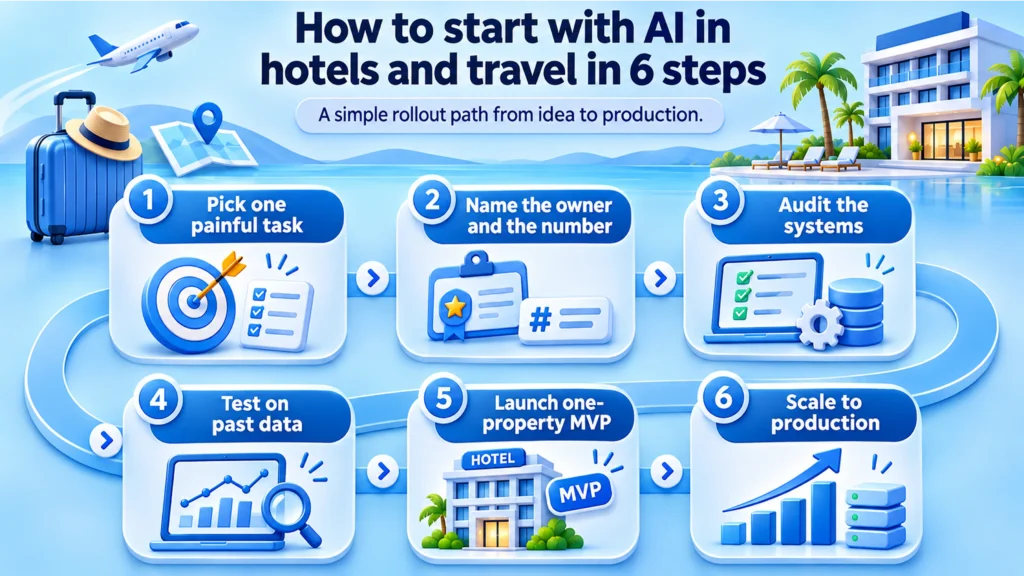
How to start with AI in hotels and travel in 6 steps
- Pick one painful task. Choose a job that costs hours every week, such as answering pre-arrival questions or reviewing rates.
- Name the owner and the number. Agree who runs it and which metric must move, for example reply time or forecast error.
- Audit the systems. Run the checklist above and fix the worst data gap before any model work starts.
- Build a proof of concept on past data. Test the forecast or assistant on last season and compare it with what your team did.
- Launch an MVP in one property. Keep a person in the loop and log every suggestion the team accepts or rejects.
- Scale to production. Roll out to more hotels or markets once the numbers hold for a full month.
Example: a guest assistant for a small hotel group
This is a hypothetical scenario to show the steps, not a CodesClue client.
A group runs three city hotels in Germany and the UK. Front desk staff answer the same parking, breakfast and late checkout questions every shift. The group runs a cloud PMS with an open API and a separate CRM.
The team starts with one job: replies to pre-arrival messages. The assistant reads the booking from the PMS and answers from a list of hotel facts. It offers paid extras only from the live price list. Anything about refunds or complaints goes to the duty manager with a draft reply.
In month one, the front office lead checks a sample of replies daily. The group tracks reply time, hand-over rate and extras sold against the month before. Only then does it add the other two hotels.
How to measure results
Pick the metric before launch and keep a baseline, such as last year or a hotel without the feature.
| Use case | Main metric | Guard metric |
|---|---|---|
| Rate suggestions | RevPAR (revenue per available room) | Occupancy and rate parity across channels |
| Guest messaging | First reply time, share solved without staff | Guest satisfaction and complaint rate |
| Upsell offers | Extra revenue per booking | Unsubscribe rate |
| Housekeeping plans | Rooms ready by check-in time | Staff overtime |
| Disruption rebooking | Time to rebook each guest | Refund and escalation rate |
Pro tip: Always pair a money metric with a guard metric. A pricing model can lift rates and quietly empty your rooms on weeknights.
What we see in real projects
To be clear, CodesClue has not yet shipped a hotel, airline or travel booking product. These related builds use the same building blocks.
- RideReach. A taxi advertising platform for a mobile advertising company in Manchester. It maps campaigns to vehicles or routes and shows live vehicle and impression data, which is close to the live inventory problem in travel.
- Nexus PTT. Push-to-talk radio software that staff use at stadiums and arenas. The client works in US sports and live events. It shows how venue staff tools handle roles, devices and live session data.
- Therapix.AI. AI drafts clinical notes, and clinicians review, edit and approve them before storage. Guest replies and rate changes need the same draft and approve pattern.
Across these projects, one lesson repeats. The integration work takes longer than the AI work, so we plan the data links first. Restaurant outlets inside a hotel can also borrow ideas from our guide to AI in restaurants and our food service software work.
Common mistakes to avoid
- Buying a chatbot before fixing guest profiles. Duplicate CRM records make every personal offer feel random.
- Letting the agent touch money on day one. Start with read-only actions and add charges later, with approval.
- Training on pandemic years without labels. Mark 2020 and 2021 as unusual, or forecasts learn the wrong season.
- Measuring the demo, not the property. A good test chat means little until staff use it for a month.
- Forgetting the channel manager. A rate change that misses one channel breaks rate parity.
Getting started with AI in travel and hospitality
AI in travel and hospitality pays off when it removes one repeated task and uses data you already trust. Keep a person in charge of money and exceptions. Start with one hotel or one route, prove the number, then grow.
CodesClue designs every product with AI in mind from the first workshop. The engineers behind our builds sit in Ahmedabad, and our other two offices are in Dortmund and in Malvern, near Philadelphia. We like to test the riskiest idea in a quick proof of concept and ship a lean MVP next. Only then do we harden it for production, with a demo for you at the end of every Agile sprint.
Our AI development, AI agent, generative AI, data visualisation and mobile app teams can work as one squad. For more depth, read our AI predictive analytics guide and AI agents guide.
Tell us about your property or travel product and the task that eats the most staff time. We will suggest the first use case and the cost band it fits. Need more hands instead? Our ML engineers can also join your own staff. Development starts within 48 hours.
FAQs
Will AI replace front desk staff at our hotel?
No. It takes over the repeated questions and the paperwork, such as parking rules, breakfast times and booking changes. Your team then has more time for arrivals, problems and guests who want a real conversation. In our view, the best results come when staff can see what the assistant said and step in at any point. Guests notice good service, not who typed the first reply.
Can AI work with an older, on-premise PMS?
Often, yes, but it takes more work. If the PMS has no open API, a small connector can read exports or the database on a schedule. Live room status and instant updates may not be possible that way. Check your licence terms before you connect anything. If you plan to move to a cloud PMS within a year, it is usually smarter to wait and build on the new one.
Is it safe to send guest messages to a public AI model?
Only with the right setup. Use a business plan or cloud service that does not train on your data, and sign a data processing agreement with the provider. Strip card numbers, passport details and health notes before any text leaves your systems. Keep EU guest data in a region your privacy policy names. A consumer chat app on a staff phone is the riskiest option.
Which AI use case should a small independent hotel try first?
Start with guest messaging before arrival. It needs little history, the questions repeat, and you can judge the replies yourself within days. A ready-made tool that plugs into your PMS is usually enough. Leave rate forecasting for later, because a small hotel with thin booking history gets shaky forecasts.
How long does a first AI project for a travel company take?
A proof of concept on past data usually takes a few weeks. A first live release in one hotel or market often follows within two to three months, depending on how open your systems are. Connecting the PMS, CRS and CRM takes most of that time. A multi-supplier booking agent with payments can take six months or more.