
AI Development Process Explained: From Idea to Deployment
The AI development process in 7 stages, from problem framing to monitoring. Pick the right route, avoid common mistakes and see what a first build costs.
You have an idea for an AI feature. Maybe it sorts support tickets, reads invoices or drafts clinical notes. A weekend demo looks great, and then the hard questions start. What data do we need, who will run it, and why did the pilot stall?
The answer is rarely the model. It is the AI development process around it. This guide walks you through the seven stages from idea to working product. You will also see which route fits your budget and where most projects go wrong.
Key Takeaways
- A sound AI development process starts with one business decision and one number that proves success.
- Data work, not model training, takes most of the effort and sets the limit on quality.
- Most products start on an existing model through an API, then fine-tune once real usage justifies it.
- Plan deployment, security and monitoring before launch, because models lose accuracy as the world changes.
- Move from proof of concept to MVP to production, and let each step earn the budget for the next.
What is the AI development process?
The AI development process is the set of stages that turns a business problem into an AI system people use every day. It runs from problem framing and data preparation through model choice, training, testing and deployment. It never really ends. Monitoring and retraining keep the model accurate after launch.
People often call it AI model development, but the model is only one part. Regular software keeps doing the same job until someone edits the code. An AI model can get worse with no code change at all, because the data it sees drifts away from the data it learned from.
That one difference shapes every stage below. For the general phases of any build, see our custom software development process guide.
Plenty of companies have started. McKinsey found that 88% of organizations use AI in at least one business function. Yet only 7% say AI runs at full scale across the company (McKinsey, December 2025 (opens in a new tab)). Most of that gap comes down to process.
The AI development lifecycle at a glance
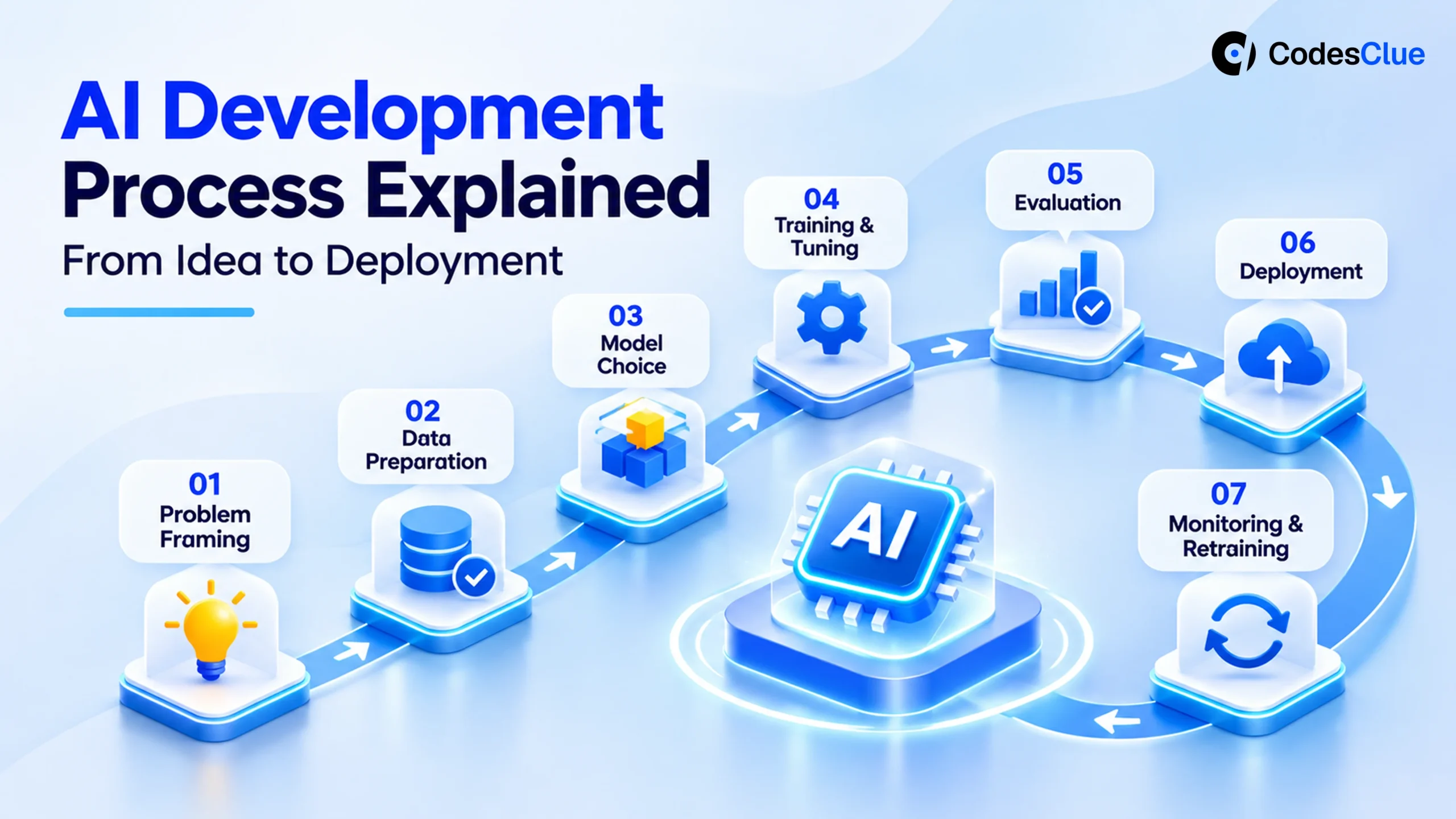
Here is the whole AI development lifecycle on one screen. Each stage answers one question and hands a clear output to the next.
| Stage | The question it answers | What you get | Who leads |
|---|---|---|---|
| 1. Problem framing | Which decision should AI improve, and how will we measure it? | A one-page brief with a success metric | Product owner and AI lead |
| 2. Data preparation | Do we have enough clean data that we may legally use? | A clean, labeled data set with version history | Data engineer |
| 3. Model choice | Call an API, fine-tune or build our own? | A chosen route and a simple baseline | ML engineer |
| 4. Training and tuning | Can the model learn the task well enough? | A trained model with logged experiments | ML engineer |
| 5. Evaluation | Does it hold up on new data, odd inputs and fairness checks? | A test report against the success metric | ML engineer and QA |
| 6. Deployment | Can real users and systems rely on it? | An API or feature in production | DevOps and MLOps engineers |
| 7. Monitoring and retraining | Is it still accurate next month? | Dashboards, alerts and a retraining plan | MLOps and product owner |
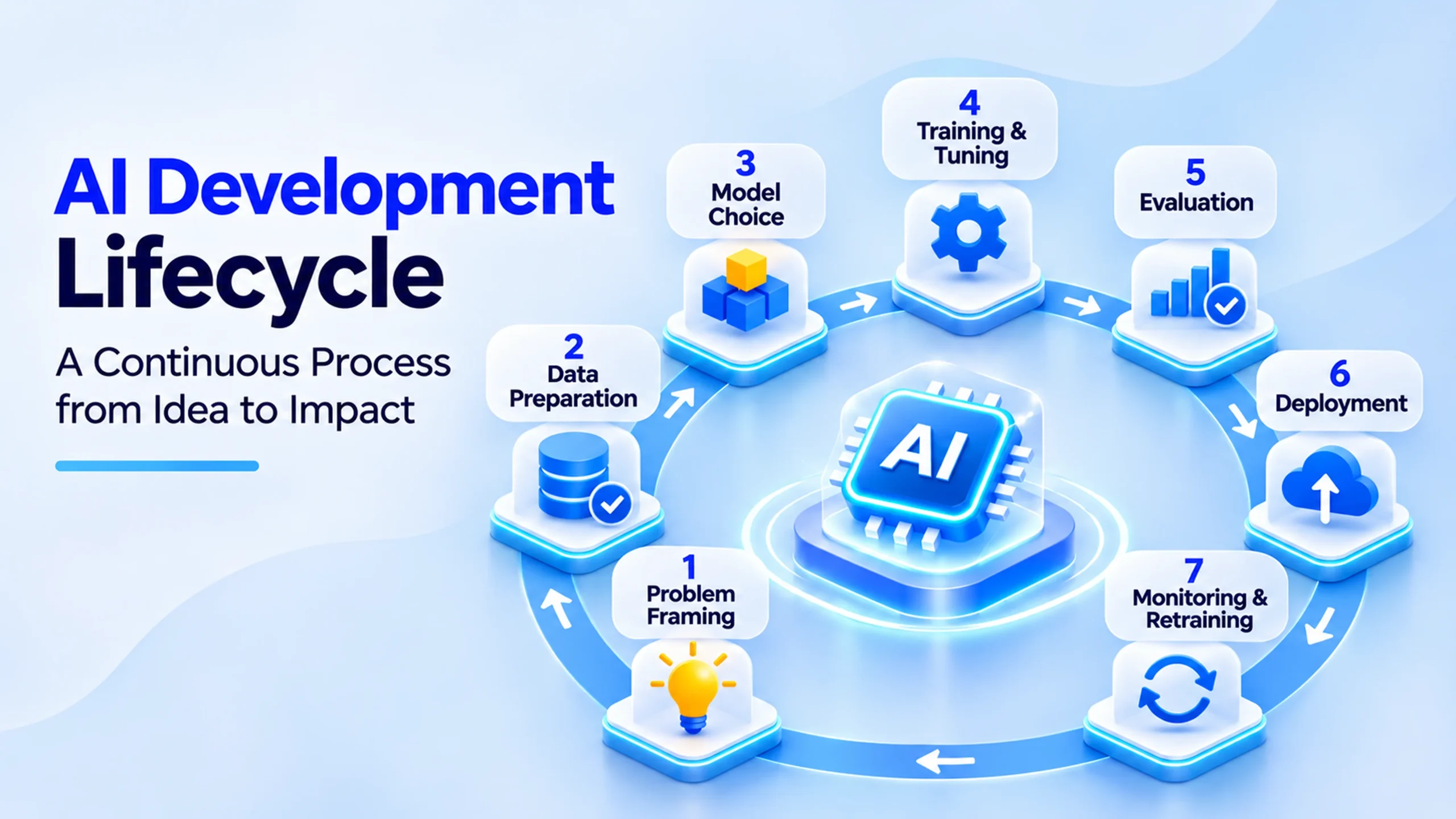
Treat the stages as a loop, not a straight line. Monitoring sends fresh data back to Stage 2, and that loop keeps the model useful long after launch.
How to build an AI model, step by step
Most guides on how to build an AI model jump straight to algorithms. The AI development process we follow starts much earlier. In real projects, the first two stages decide most of the outcome. Here is what each stage involves and what we watch for.
Stage 1: Frame the problem before you touch data
Start with the decision, not the technology. “Add AI to our help desk” is a wish. “Route seven in ten tickets to the right team with no human triage” is a target you can test.
- Name the user and the decision the model improves.
- Pick one success metric, such as minutes saved per case or cost per prediction.
- Ask whether simple rules already solve most of the problem. If they do, start there.
Stage 2: Collect and prepare the data
Your data sets the ceiling for every model. This stage usually eats the most hours and brings the most surprises. Gartner predicts that through 2026, organizations will abandon 60% of AI projects that lack AI-ready data (Gartner, February 2025 (opens in a new tab)).
- Audit what you hold: volume, gaps, owners and consent to use it.
- Clean the records, remove duplicates and add labels. Keep a version history of each data set, the way you do for code.
- Split the data into training, validation and test sets before any training starts.
Pro tip: Ask for 200 real examples in week one. If nobody can produce them, you have found your first project risk, and finding it cost nothing.
Stage 3: Choose the model approach
You rarely need a new model design. Most products today start on a large ready-made model, either called through an API or adapted with your own data.
For agents on open models, see our guide to building a custom AI agent with open source LLMs. For tables of business data, classic machine learning such as gradient boosting often beats deep learning.
Whatever you pick, build a simple baseline first. Every later model must beat it, or it does not ship.
Stage 4: Train and tune
Training teaches the model the patterns in your data. Tuning adjusts its settings until results stop improving. On an API or fine-tuned model, this stage also covers prompt design and the document search setup.
- Log every experiment: data version, settings and scores.
- Watch for a model that memorizes. Training scores look great while validation scores lag behind.
- Stop when you reach the business target from Stage 1, not when the ideas run out.
Stage 5: Evaluate like a skeptic
Test the model on data it has never seen. Then try edge cases, messy inputs and prompt injection attempts, where a user hides instructions in the text. Compare results across user groups, so a strong average cannot hide a weak segment. For generative models, measure how often the model gives wrong or invented answers.
The NIST AI Risk Management Framework (opens in a new tab) is a free, voluntary guide that groups this work into four functions: govern, map, measure and manage. Teams in health, finance and other regulated sectors can use it as a checklist for risk reviews.
Pro tip: Freeze the test set early, and keep it away from the people tuning the model. A test set the team has studied stops being a fair test.
Stage 6: Deploy into the real product
Deployment turns a model file into a service your product calls. Here the AI software development process meets ordinary engineering: sign-in, logging, rate limits and cost control. Our AI prototype to production checklist covers those launch items in detail.
- Set a latency budget and a cost per request before launch.
- Release in steps. Start in shadow mode, where the model runs but users do not see its answers. Then open it to a small share of users, then everyone.
- Keep a fallback, such as a rule or a human queue, for times when the model is down or unsure.
Stage 7: Monitor, retrain and improve
Models drift. Customer habits change, new products launch and accuracy slips without any error message. Track input data, predictions and user feedback. Set a retraining trigger, such as accuracy falling below the Stage 1 target or a big change in the business.
Pro tip: Give Stages 2, 6 and 7 the same weight in the budget as training. They decide whether the model survives its first year.
Which route fits you: API, fine-tuning or a model from scratch?
Many founders ask how to train a model from scratch. Most should not. The right route depends on how unique your data is and how much control you need. Retrieval, often called RAG, means the model looks up your own documents before it answers.
| Factor | Call an existing model (API) | Fine-tune or add retrieval | Build from scratch |
|---|---|---|---|
| First working version | Days to weeks | A few weeks | Months |
| Data you need | Very little | Hundreds to thousands of good examples | Large labeled data sets from your field |
| Fit for your niche | General | Strong | Strongest, if the data allows |
| Control and privacy | Limited, data leaves your stack | Good, can run in your own cloud | Full |
| Running cost at scale | Grows with every call | More predictable | Steady, but needs your own infrastructure |
| Best for | Prototypes, chat, summaries | Most business products | Unique data, strict rules, core IP |
Our usual path is simple. Prototype on an API, prove value with real users, then fine-tune or train your own model once volume, cost or privacy calls for it. For price ranges by route, read our machine learning development cost guide.
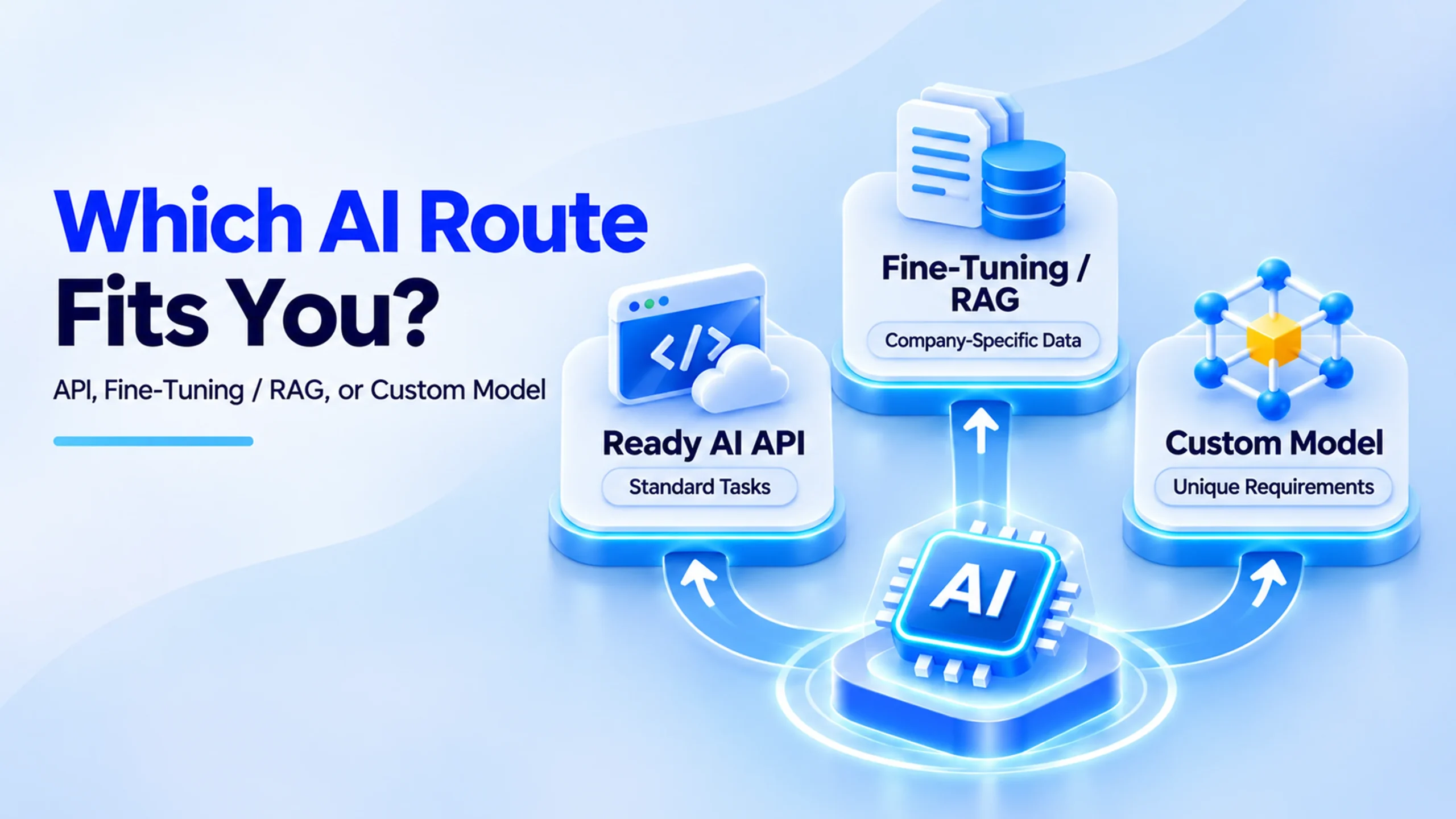
Not sure which route suits your idea? Describe the decision you want AI to make, and we will tell you which route we would test first.
A real example: the stages behind Therapix.AI
Therapix.AI is a clinical documentation platform we built for therapists and clinicians. It turns session details into structured notes, such as SOAP reports. Here is how the stages looked in practice.
- Framing. We mapped how clinicians really work first. The goal was less time on paperwork, not AI notes for their own sake.
- Model output. The AI had to produce structured, editable documents that stayed consistent across different therapy styles.
- Evaluation and trust. Clinicians review, edit and approve every note before the system stores it. We built that review step in so clinicians could trust the output.
- Deployment. Access controls and data handling followed healthcare security needs from day one, across web, iOS and Android.
- Room to grow. A modular design lets new AI features and reports plug in without rework.
The case study reports a 62% cut in documentation time and a 70% drop in admin workload. The lesson carries over to any project. The review step and the fit with daily clinical work mattered as much as the model.
AI model development challenges and common mistakes to avoid
The odds are worse than for regular software. RAND cites estimates that more than 80% of AI projects fail, about twice the rate of IT projects without AI (RAND, August 2024 (opens in a new tab)). Its interviews with 65 data scientists and engineers point mostly to people and process causes, not weak algorithms.
These are the AI model development challenges we meet most often:
- A vague goal. The team builds an impressive model for the wrong problem. Agree on one metric in Stage 1.
- Data that is not ready. Months vanish into cleanup and access requests. Audit the data before you fund training.
- Chasing the newest model. Cost rises while results barely move. Beat a simple baseline first.
- No path to production. The model works on a laptop and nowhere else. Bring engineers in from week one.
- Silent drift. Accuracy slides for months before anyone notices. Ship monitoring with the first release.
- Security as an afterthought. Prompt injection and data leaks surface after launch. Design access rules and logging up front.
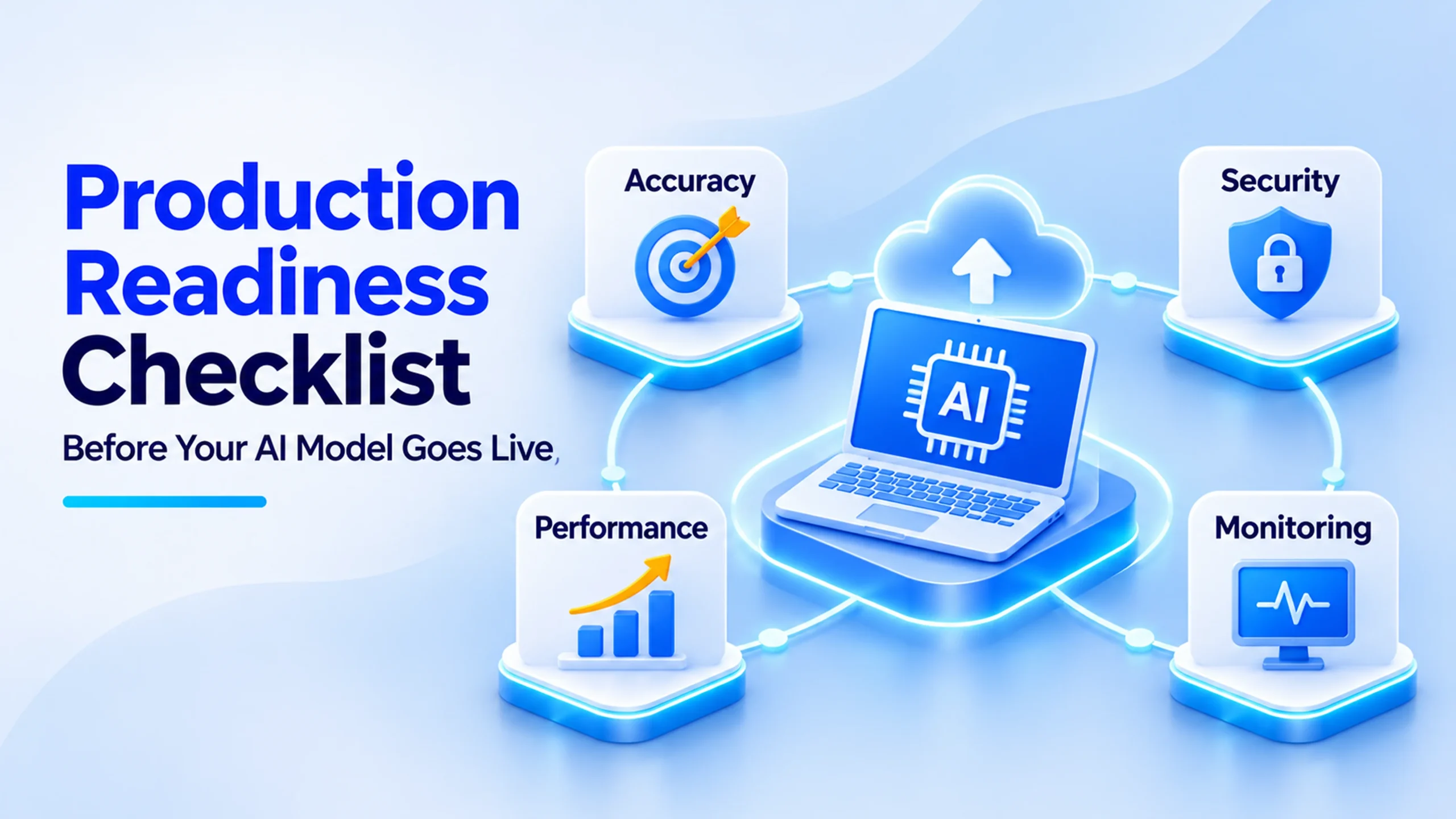
A production readiness checklist
Before you call a model ready, check each line. If one is missing, it is not ready yet.
- It meets the Stage 1 metric on test data it has never seen.
- It handles bad inputs, edge cases and abuse attempts safely.
- It answers within your latency and cost limits at expected traffic.
- A fallback exists for outages and low-confidence answers.
- Monitoring alerts a named person when accuracy or input data drifts.
- A new engineer could retrain and redeploy it from your own notes.
How CodesClue runs custom AI model development
CodesClue is an AI-first software company. Our engineers work from Ahmedabad, and we have offices in India, the USA and Germany. For custom AI model development, we split the work into three gates, each run in short Agile sprints:
- Proof of concept. Test the riskiest assumption on real data, fast and cheap. Stop here if it fails.
- MVP. Put the model in front of real users inside a small product, with basic monitoring. Our MVP development guide shows how we scope that first release.
- Production. Harden security, scale the infrastructure and set up retraining.
This keeps the AI model development process honest, because each gate has to earn the budget for the next. Our AI development services cover all seven stages. Projects built on existing language models go to our LLM integration team. For classic prediction work, see our machine learning development services.
What CodesClue charges
Price depends on the route, the state of your data and how deep the integration goes. Our project ladder:
- $8K to $25K: an MVP or proof of concept on one use case, usually built on an existing model.
- $25K to $70K: a mid-size build with fine-tuning or retrieval, links into your systems and monitoring.
- From $70K: a large build, such as a custom-trained model, several AI features or a platform with retraining pipelines.
For a full breakdown by app type, read our AI app development cost guide. Want AI engineers inside your own team instead? Then hire AI developers who join your own sprints. Once you approve a developer, development starts within 48 hours.
When you should not build AI yet
Sometimes the honest advice is to wait. A simple rule or a better form may already solve most of the problem. You may hold only a few weeks of data on the decision. Or nobody on your team has time to act on what the model says.
In each case, fix the process first and come back to AI with a sharper question.
Pro tip: Write down what the model will replace and what that work costs today. If you cannot put a number on it, the business case is not ready.
Getting your AI development process right
A good AI development process is narrow at the start and disciplined at the end. Frame one decision, prove your data, pick the simplest route, test hard, release in steps and keep watching after launch.
Bring us your idea and the decision it should improve. We will map it to the seven stages, flag the risky ones and tell you honestly where we would start. Talk to an AI engineer.
FAQs
Can I build an AI model without an in-house data science team?
Yes, for many products. Ready-made models now do much of the hard research work, so the job shifts toward data preparation and software engineering. You still need people who can test the model, secure it and run it in production. An outside team can cover those roles while you decide whether to hire. Keep one person on your side who owns the business metric.
What should a proof of concept prove before you fund an MVP?
It should answer one risky question with your real data, not demo data. For example, can the model reach the agreed accuracy on 200 of your own cases? It should also show a rough running cost per request and any blockers in data access. If the answer is a clear no, stopping there is a good result, because it saves the MVP budget.
Who should own the AI model if an outside team builds it?
You should, and the contract should say so in writing. Ask for ownership of the code repository, the trained model weights, the data sets and the cloud accounts. Also ask for setup notes and test results, so another team could take over. If a vendor keeps the model on its own account, you cannot move it, audit it or retrain it without them.
Does the EU AI Act change the AI development process?
It can, if you serve users in the EU. The Act sorts AI uses by risk. High-risk uses, such as hiring or credit scoring, carry extra duties on data quality, documentation, human oversight and logging. Most chat assistants and internal tools face lighter rules, mainly telling people they are talking to AI. Check your use case early, because these duties shape data work, testing and deployment.
How does generative AI change the model development work compared with classic machine learning?
Classic machine learning predicts a number or a label, such as churn risk, and you train it on your own history. Generative AI writes text, images or code, and you usually start from a large ready-made model. The stages stay the same. Testing changes most, because generative output needs checks for invented facts, tone and unsafe answers as well as accuracy.