
Healthcare Software Development Cost in 2026: What Drives the Budget
Healthcare software development cost in 2026: price bands by software type and feature, compliance and integration costs, rates and ways to cut the budget.
Healthcare software development cost is the first thing clinic owners, health startup founders and hospital IT leads ask us about. The quotes they get rarely agree. One vendor says $30,000, another says $300,000, and both call it a patient app. The gap comes from three things: how much patient data the software touches, how many systems it talks to and how much goes into the first release. This guide shows where the money goes, so you can set a budget you can defend and compare quotes on equal terms. If you already have a project in mind, our healthcare software development services page shows what we build.
Key Takeaways
- With us, a healthcare build usually falls into one of three budgets. A narrow first version costs $8K to $25K. Plan on $25K to $70K for a middle-sized product. Hospital-grade platforms start from $70K.
- Compliance and integrations move the price more than screens do. Each EHR, lab or billing connection is its own piece of work.
- HIPAA does not have a fixed price tag. You pay for safeguards such as access control, audit logs and encryption, and they cost far less than a breach.
- Hourly rates explain only part of the bill. Rework, management time and slow answers can erase an offshore saving.
- Plan for running costs from day one: hosting, security testing, store fees and steady updates after launch.
How much does healthcare software development cost in 2026?
In 2026, healthcare software development cost begins around $8K to $25K when the first release is small. Think of a booking app or an internal clinical tool. A patient portal or a telehealth product with one or two integrations runs $25K to $70K. EHR systems, hospital platforms and device data products start from $70K and often go well beyond it.
Published guides from other vendors show the same shape at higher numbers. Fingoweb lists $40K to $200K for a patient portal and $75K to $500K for a custom EHR. Tenet puts a telemedicine app at about $30K to more than $300K. The spread is wide because “healthcare software” covers everything from a reminder app to a hospital system.
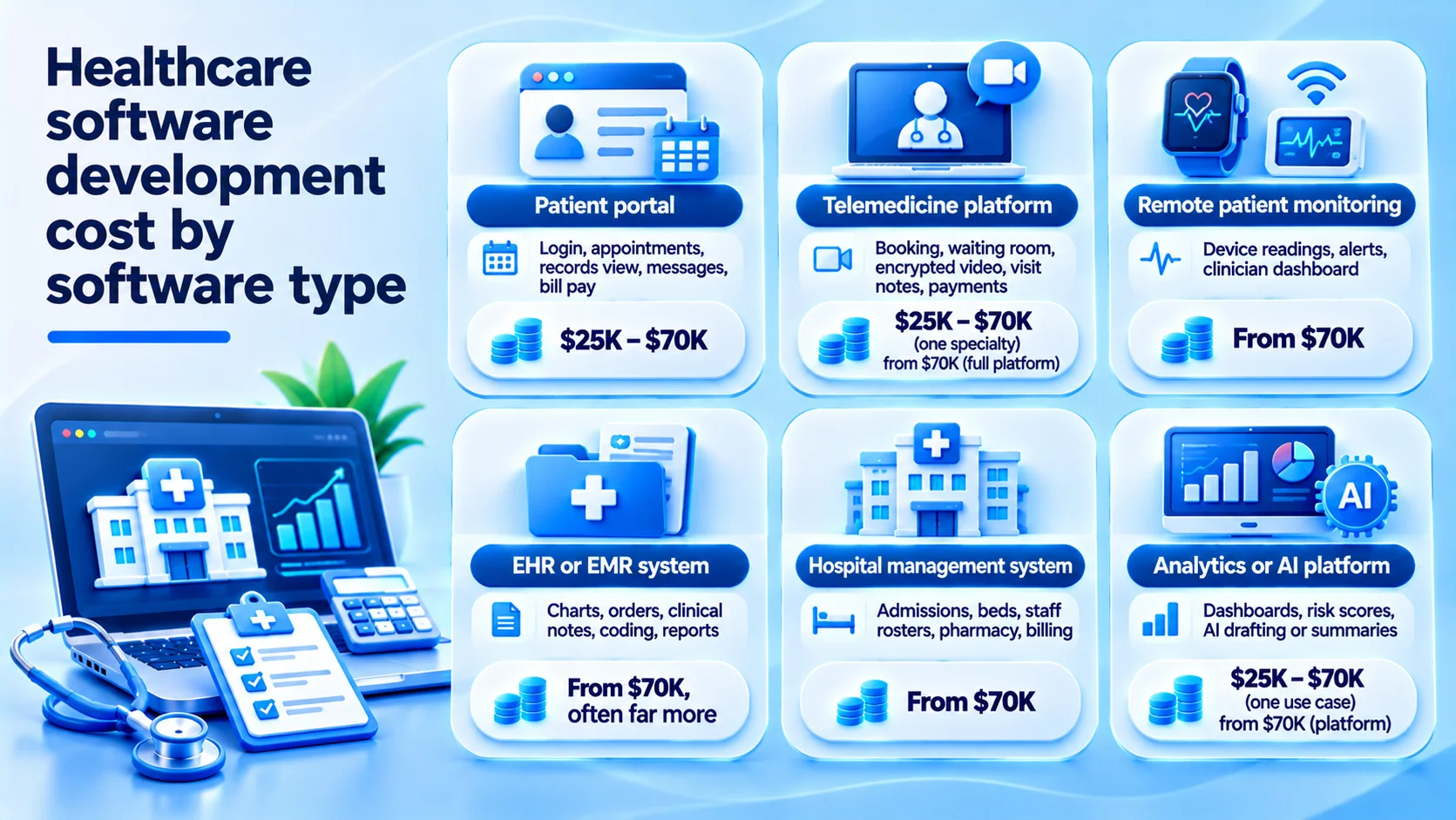
Healthcare software development cost by software type
The fastest way to estimate the cost to build healthcare software is to start from the product type. Each row below matches a product line we build, with the band most of these projects fall into with us.
| Software type | What it covers | Usual CodesClue band | What pushes it to the top |
|---|---|---|---|
| Patient portal | Login, appointments, records view, messages, bill pay | $25K to $70K | Two-way EHR sync, family accounts, several languages |
| Telemedicine platform | Booking, waiting room, encrypted video, visit notes, payments | $25K to $70K for one specialty, from $70K for a full platform | E-prescribing, insurance checks, web plus iOS plus Android |
| Remote patient monitoring | Device readings, alerts, clinician dashboard | From $70K | Many device types, offline sync, alert rules per patient |
| EHR or EMR system | Charts, orders, clinical notes, coding, reports | From $70K, often far more | Specialty templates, certification goals, data migration |
| Hospital management system | Admissions, beds, staff rosters, pharmacy, billing | From $70K | Number of departments, legacy systems, round-the-clock uptime |
| Analytics or AI platform | Dashboards, risk scores, AI drafting or summaries | $25K to $70K for one use case, from $70K for a platform | Data cleanup, model review steps, many data sources |
These bands come from our own delivery work. Your final figure depends on scope, so treat the table as a starting point for a conversation, not a quote.
Pro tip: Write down the one workflow your first release must fix. For example, patients book and pay without calling the front desk. A single clear workflow often keeps a project in the lower band.
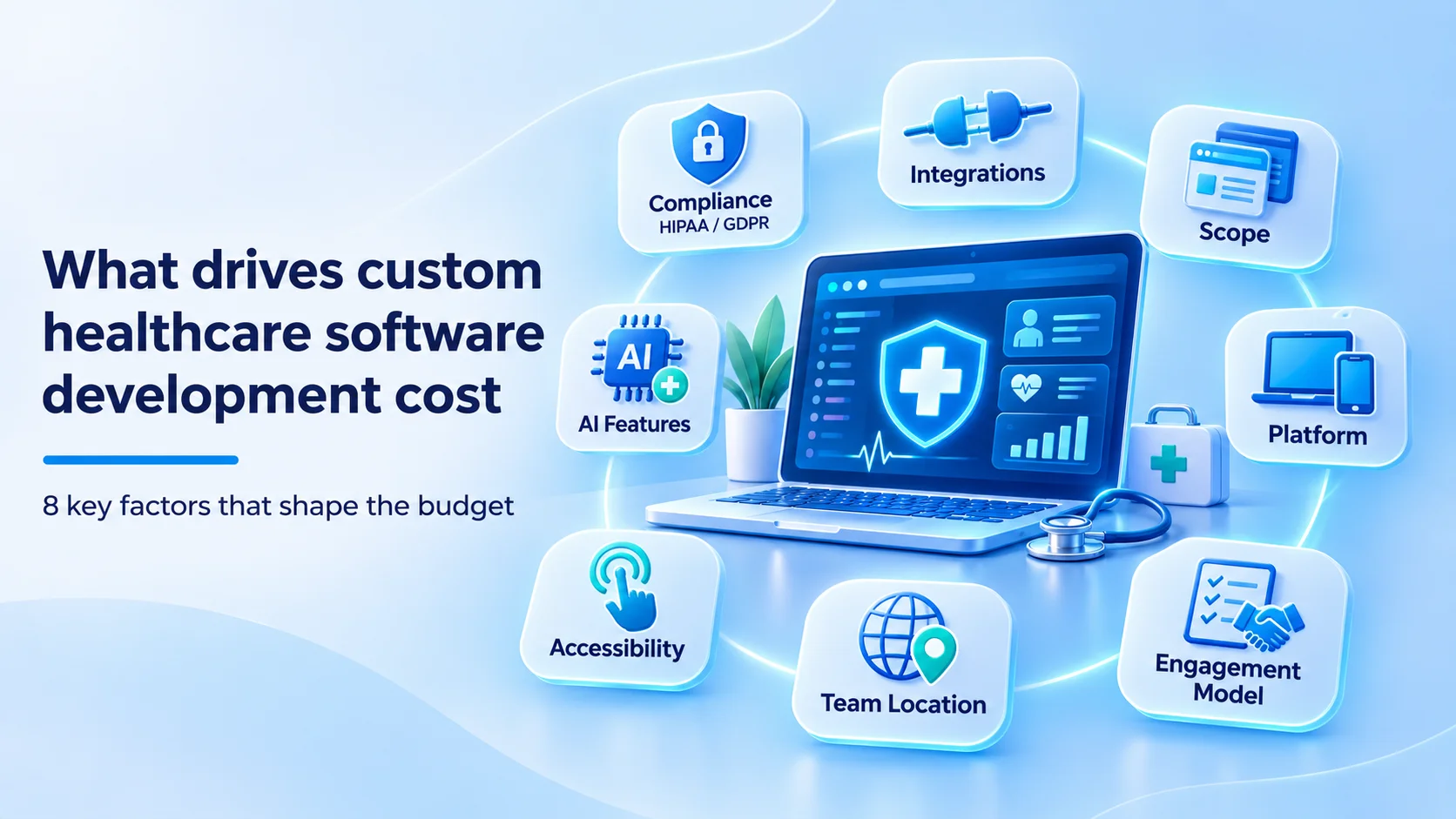
What drives custom healthcare software development cost
Eight factors decide where your custom healthcare software development cost lands. The first two, compliance and integrations, explain most of the difference between quotes.
1. Compliance scope (HIPAA, GDPR or both)
Software that stores or shares protected health information needs HIPAA safeguards. Think personal logins for every user and access tied to job roles. Add encrypted data, a record of who opened what and backups you have restored at least once. Serving EU patients adds GDPR work, such as consent records, data export and deletion on request and EU data residency. Each rule set adds design, build and test time to every feature that touches patient data.
2. Integrations
Every outside system is a separate project inside your project. A read-only link that pulls a patient summary from an EHR is far smaller than a two-way sync that writes orders and notes back. Labs, pharmacies, insurers and payment providers each bring their own formats, test sandboxes and approval steps.
3. Scope and features
User roles multiply effort. A product for patients only is one thing. Add clinicians, admins, billing staff and caregivers, and each role needs its own screens, permissions and tests.
4. AI features
AI drafting, summaries and triage add model costs, review screens and audit trails. In clinical use, a person checks AI output before it reaches a chart. Budget for that review step as a feature in its own right.
5. Platform choice
A web app alone costs the least. Native iOS and Android apps cost the most. Cross-platform tools such as Flutter or React Native share one codebase across both stores and usually sit in between.
6. UX and accessibility
Patients include older adults and people with low vision. Larger touch targets, readable contrast and screen reader support add design and test time, and they also cut support calls after launch.
7. Team location
Where the team sits sets the rate, but not the whole cost. We cover the numbers and the trade-offs in the hourly rate section below.
8. Engagement model
A fixed price suits a clear scope. A product that shifts every month fits a dedicated team better. Picking the wrong model adds change requests or idle time to the bill.
Healthcare app development cost breakdown by feature
Features rarely carry a fixed price, because the same feature can be simple or deep. The table shows what each one involves and how much weight it adds to a healthcare app development cost.
| Feature | What it involves | Relative effort | When it gets expensive |
|---|---|---|---|
| Login and two-step sign-in (MFA) | Sign-up, identity checks, second factor, session rules | Small | Single sign-on with a hospital directory |
| Scheduling | Provider calendars, booking, reminders, cancellations | Small to medium | Sync with an EHR calendar across many locations |
| Secure chat | Encrypted messages, attachments, read receipts | Medium | Group threads, triage rules, message retention policies |
| Video visits | Encrypted calls, waiting room, visit notes | Medium | Multi-party calls, recording, poor-network handling |
| E-prescribing | Medication search, prescriptions sent to pharmacies | Large | Controlled substances and network certification |
| EHR integration | FHIR or HL7 link to read and write patient data | Medium to large | Two-way writes, several EHR vendors, older HL7 v2 feeds |
| Device sync | Readings from wearables, glucose meters or blood pressure cuffs | Medium to large | Many device makers, offline buffering, alert thresholds |
| Dashboards | Charts and reports for clinicians or managers | Small to medium | Live data from several systems, custom report builder |
| AI symptom checker | Guided questions, suggested next step, clinician review | Large | Medical claims that bring FDA rules into play |
| Security layer | Encryption, audit logs, access roles, backups, monitoring | Medium, spread across every feature | Strict retention rules, frequent outside audits |
A typical first release, the MVP, includes:
- Patient sign-up with MFA and one clinician role
- Booking with email or text reminders
- One core workflow, such as video visits or secure messaging
- An admin screen for staff
- Audit logs, encryption and backups from the first sprint
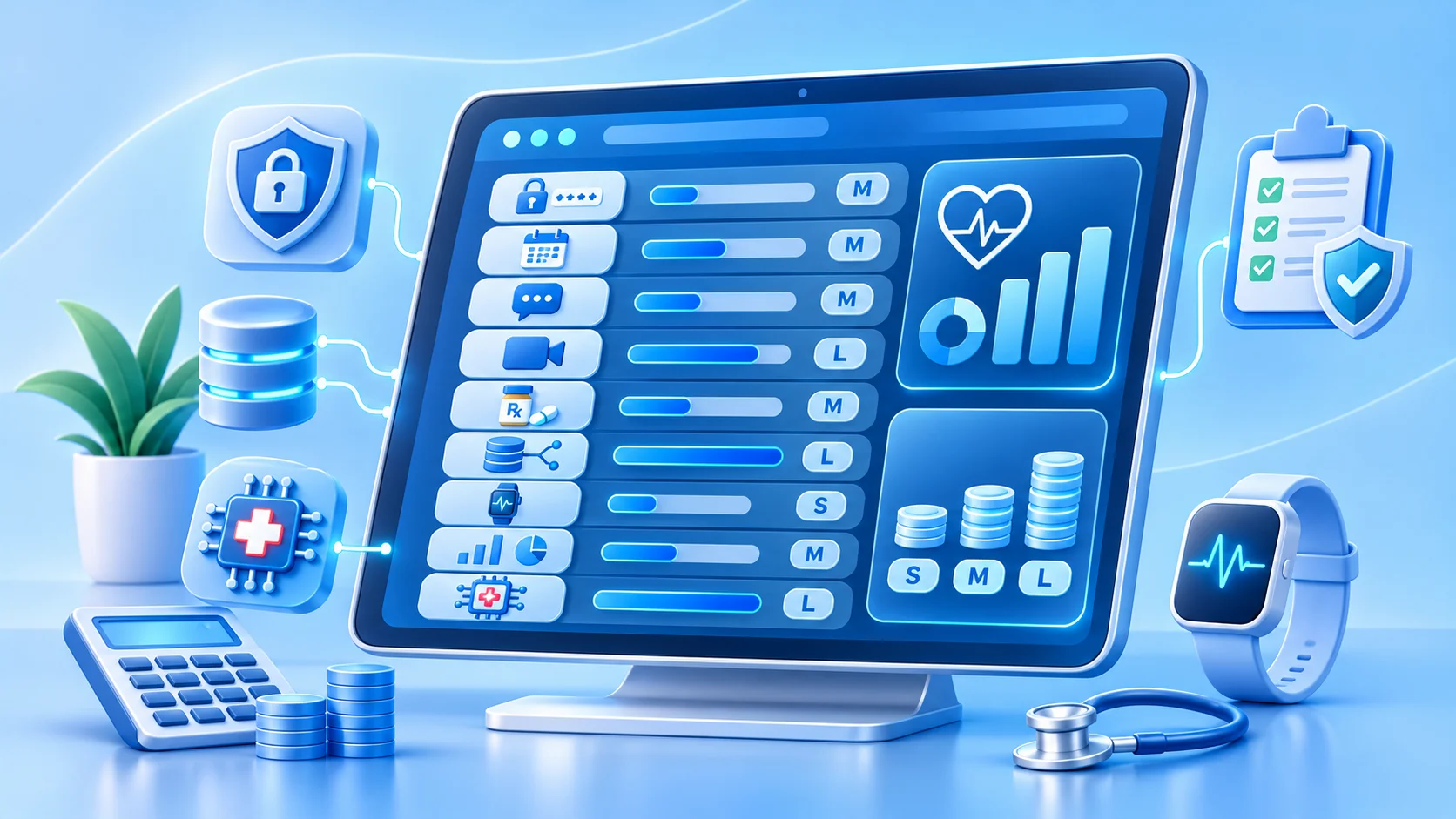
Pro tip: Ask every vendor to mark each feature as “MVP” or “later” in their quote. You will spot padded scopes at once, and you can move features between releases to fit your budget.
Cost breakdown by development phase
The budget pays for five stages. At the close of each, you get something concrete to check. Here is what each stage covers and what you receive.
| Stage | What happens | What you receive |
|---|---|---|
| Discovery and workflow mapping | We map how patients and staff work today and which systems hold the data | Scope, user roles, integration list, written estimate |
| Privacy-first architecture | We decide where patient data lives, who can see it and how we log it | Architecture plan, data flow map, hosting choice |
| Agile build from proof of concept (POC) to MVP | Short sprints of two weeks, with a clickable demo at the end of every one | Working software every sprint, test reports |
| Compliance review | We walk through the safeguards with your compliance lead and fix gaps | Control checklist, security test results |
| Launch and support | Go-live, app store release, monitoring, bug fixes and updates | Live product, support plan, handover documents |
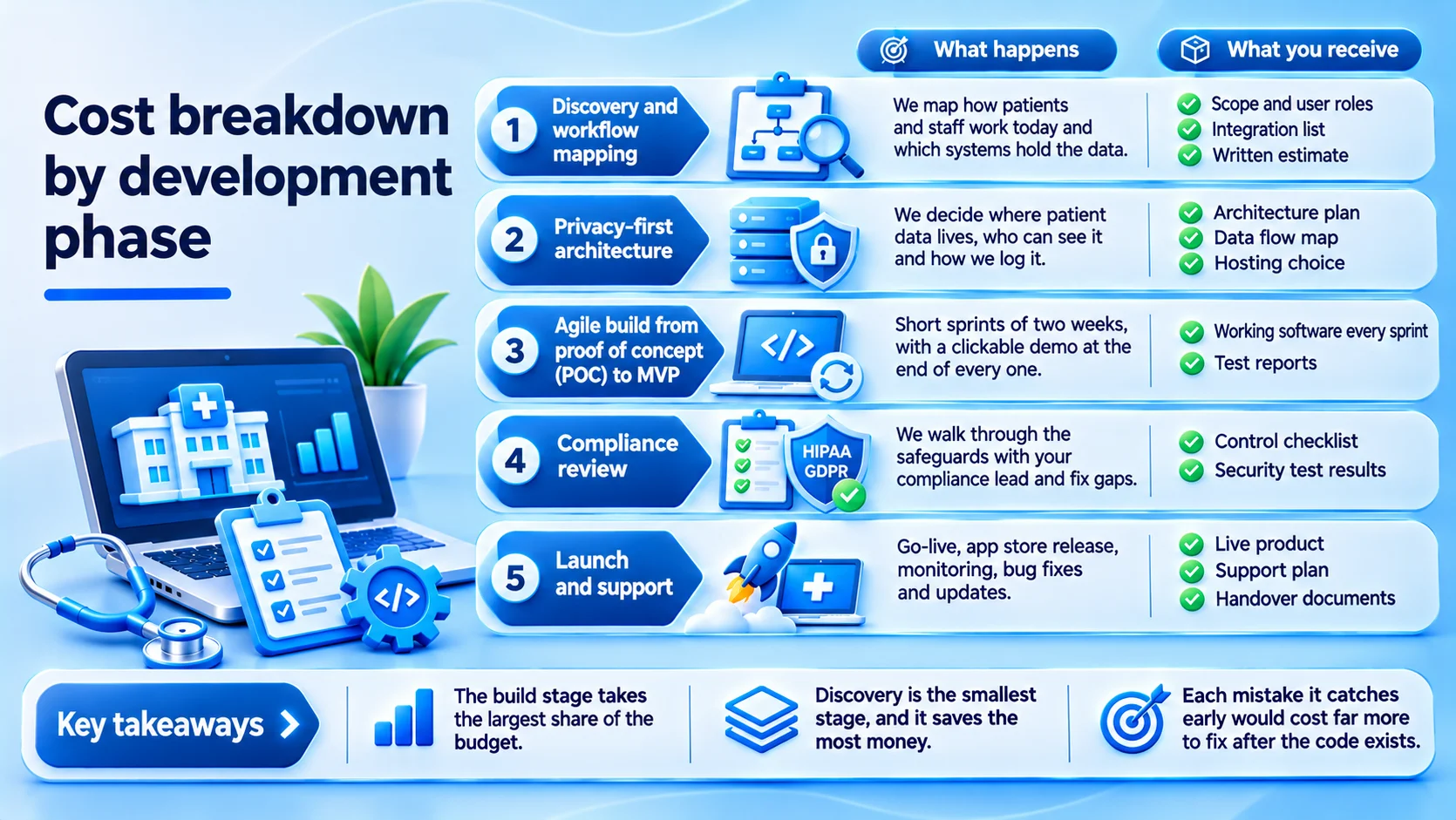
The build stage takes the largest share of the budget on almost every project. Discovery is the smallest, and it saves the most money, because each mistake it catches would cost far more to fix after the code exists.
Compliance, security and integration costs buyers underestimate
These lines are missing from many first quotes, and they show up later as change requests. Ask about each one before you sign.
- HIPAA safeguards. Nobody can certify software as HIPAA compliant, because the law offers no such certificate. What you pay for are the controls the Security Rule describes, built into every screen and API. Our HIPAA and PCI DSS guide walks through each control one by one.
- Business associate agreements. Any vendor or cloud service that handles patient data for you signs a BAA. Some hosting plans charge more for BAA coverage.
- GDPR items. Consent tracking, deletion on request, data export and EU hosting all take build and test time.
- HL7 and FHIR depth. Under the Cures Act rules, certified EHRs must offer a standardized FHIR API (opens in a new tab), which makes basic reads more predictable. Two-way writes, older HL7 v2 feeds and vendor app reviews still take weeks.
- Legacy data migration. Moving years of records means mapping old fields, removing duplicates and keeping both systems live in parallel until every count agrees.
- Third-party fees. Video, text messaging, e-prescribing networks and identity checks charge per use or per month. Publishing to phones adds store fees too: $99 every year for Apple (opens in a new tab) and $25 once for Google Play (opens in a new tab).
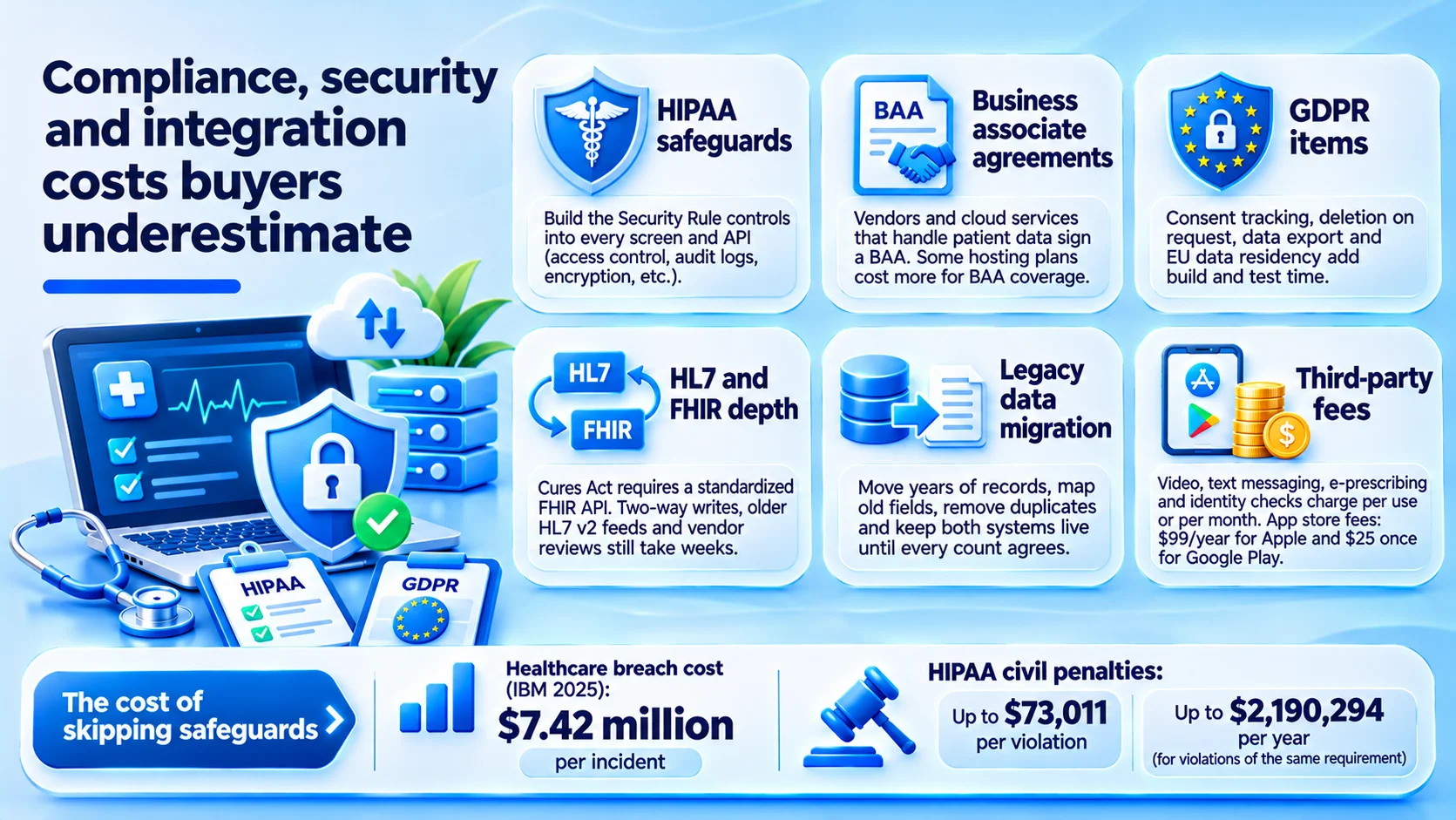
Skipping safeguards is the expensive option. In IBM’s 2025 breach research, healthcare topped every sector at $7.42 million per incident (opens in a new tab). HIPAA civil penalties reach up to $73,011 per violation in most tiers and up to $2,190,294 a year for violations of the same requirement. Those figures come from the 2025 inflation adjustment (opens in a new tab) HHS published in January 2026. For help beyond the build, see our security and compliance services.
Pro tip: Ask each vendor which patient data (FHIR resources) they plan to read and write, and in which EHR sandbox they will test. A vague answer here is the most common source of budget surprises we see.
Healthcare software developer hourly rate by region
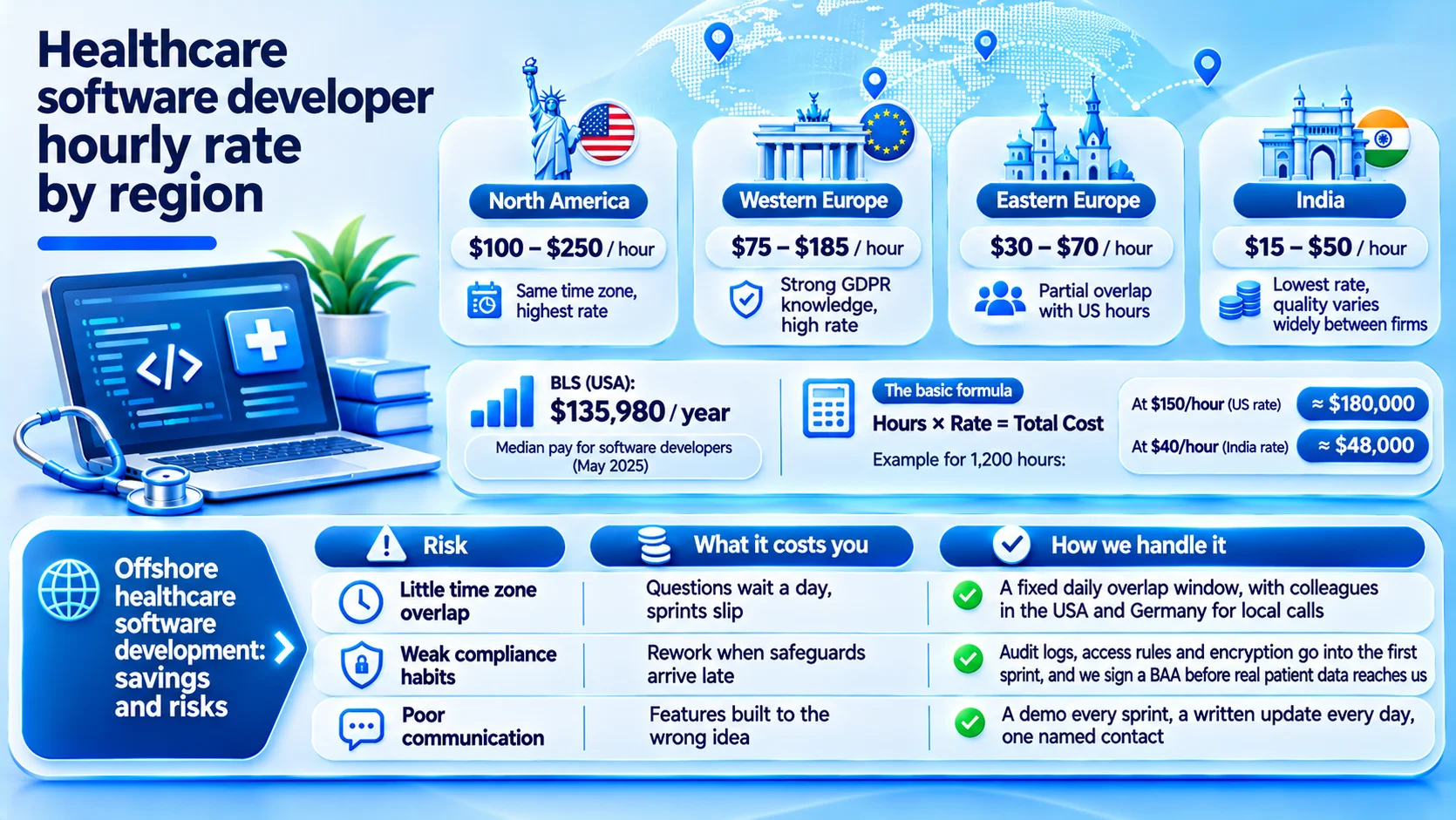
A healthcare software developer hourly rate changes a lot with location, and it also changes what you must manage yourself. In the USA, the Bureau of Labor Statistics (opens in a new tab) reports a median pay of $135,980 a year for software developers (May 2025). Benefits, office and hiring costs come on top.
Agency rates published in 2025 and 2026 cost guides show the regional spread:
| Region | Published agency rate per hour | What to weigh |
|---|---|---|
| North America | About $100 to $250 | Same time zone, highest rate |
| Western Europe | About $75 to $185 | Strong GDPR knowledge, high rate |
| Eastern Europe | About $30 to $70 | Partial overlap with US hours |
| India | About $15 to $50 | Lowest rate, quality varies widely between firms |
Source: regional rate table in Binmile’s healthcare app cost guide (2026 update). We quote by scope rather than by the hour, so you get one written figure tied to milestones.
The basic formula is hours times rate. For example, a portal that needs 1,200 hours costs about $180,000 at $150 an hour, a typical US agency rate. At $40, a typical India rate, it costs about $48,000. The hours, though, are not fixed. A team new to FHIR or HIPAA logs more of them, and rework never appears in the first estimate.
Offshore healthcare software development: savings and risks
Offshore healthcare software development saves real money, but the rate is not the whole cost. Three risks decide whether the saving survives.
| Risk | What it costs you | How we handle it |
|---|---|---|
| Little time zone overlap | Questions wait a day, sprints slip | A fixed daily overlap window, with colleagues in the USA and Germany for local calls |
| Weak compliance habits | Rework when safeguards arrive late | Audit logs, access rules and encryption go into the first sprint, and we sign a BAA before real patient data reaches us |
| Poor communication | Features built to the wrong idea | A demo every sprint, a written update every day, one named contact |
Our engineers build in Ahmedabad. With people in Germany and the USA too, clients in Europe and North America get someone nearby for calls. Need extra engineers under your own management? Read about offshore developers from CodesClue.
Pricing models and how to hire healthcare software developers
How you hire healthcare software developers shapes the budget as much as who you hire. Match the model to how settled your scope is.
| Model | Best for | Main risk | Budget predictability |
|---|---|---|---|
| Fixed price | A clear MVP with known integrations | Change requests when scope grows | High |
| Dedicated team | A product that evolves month by month | Needs active product ownership from you | Medium, a steady monthly cost |
| Staff augmentation | Adding skills, such as FHIR or mobile, to your team | You manage the work day to day | Medium |
| Retainer | Support, updates and small features after launch | Unused hours if demand drops | High |
For extra hands inside your own process, our IT staff augmentation services place screened engineers with you. Once the brief is clear and you sign off on a named engineer, development starts within 48 hours.
Hidden costs and ongoing maintenance
The build is only part of the total. Budget for these from the first month:
- Hosting on a cloud plan that covers patient data, plus backups and monitoring
- Security testing, such as a yearly penetration test and a risk assessment
- Licenses and usage fees for video, messaging, maps and identity services
- QA for every new phone model and operating system release
- Training for front desk and clinical staff
- Scope creep, the small additions that add up when nobody tracks them
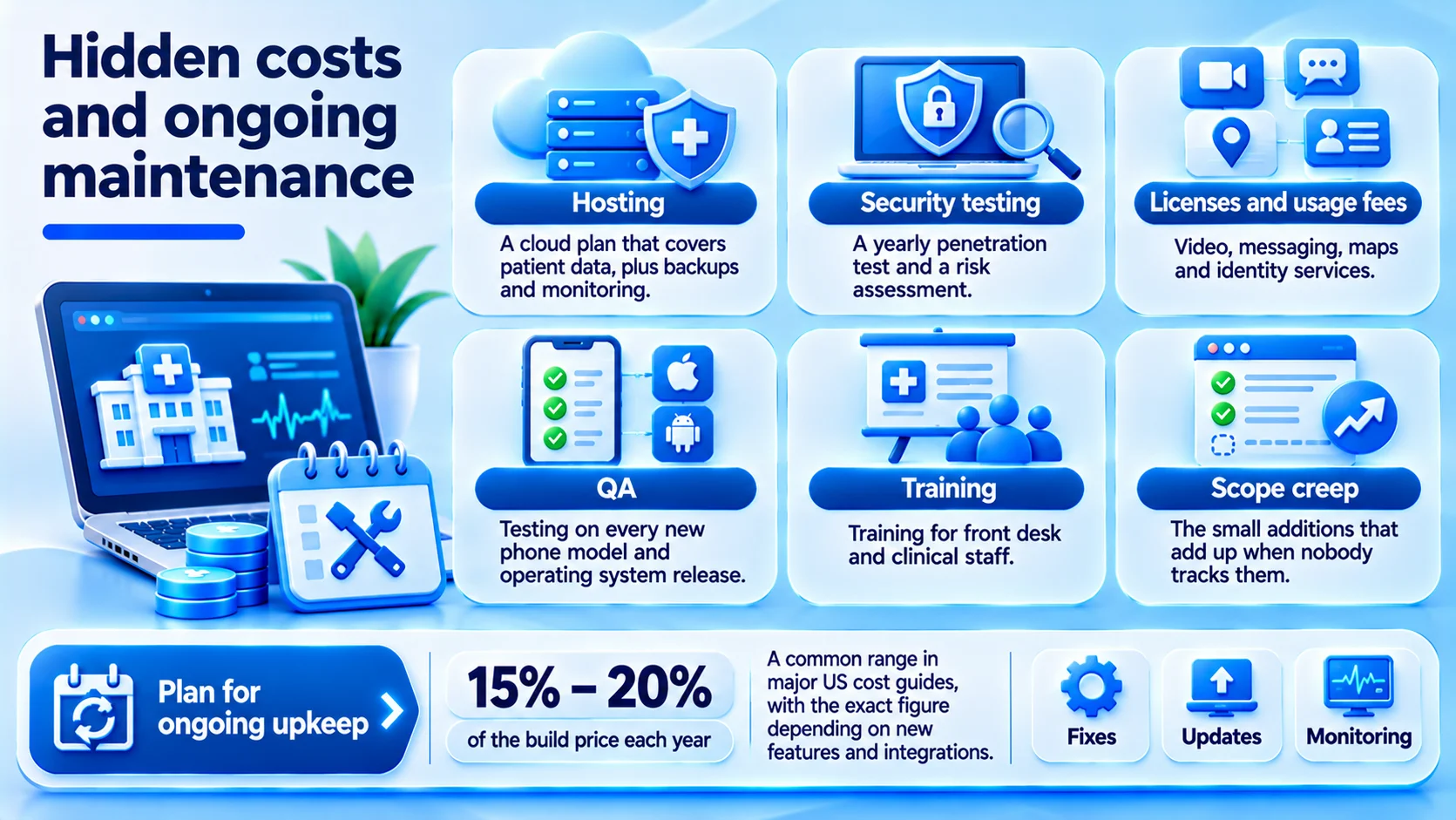
Upkeep matters too. Four of the five top-ranking US cost guides we studied set aside 15% to 20% of the build price each year for it. The real figure depends on how often you add features and how many integrations you run. Our product maintenance and support plans cover fixes, updates and monitoring after launch.
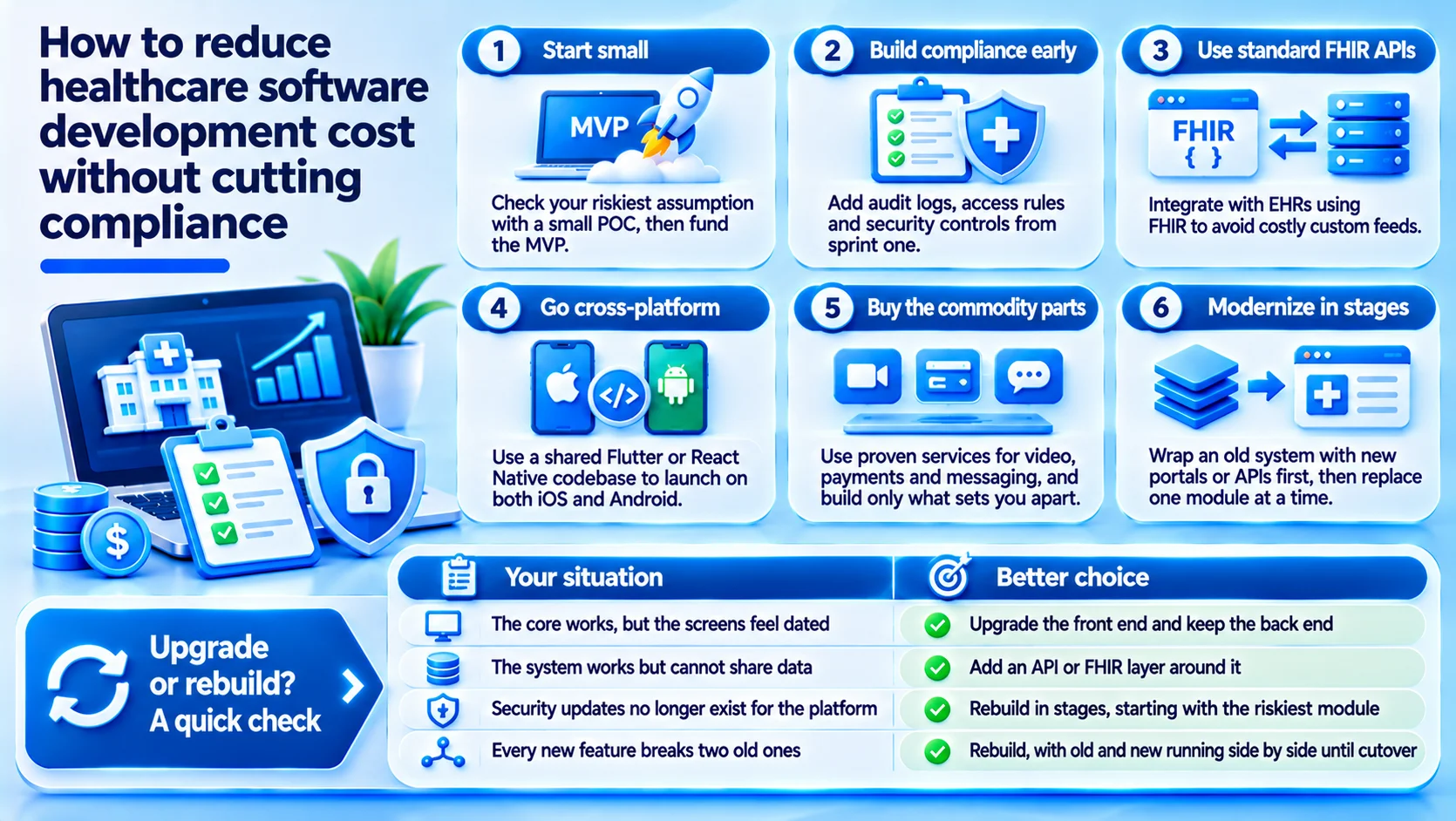
How to reduce healthcare software development cost without cutting compliance
You can lower healthcare software development cost and still protect patient data. These six steps work on almost every project:
- Start small. Check your riskiest assumption with a small proof of concept, and fund the MVP only once it holds up. Our guide to MVP app development shows how to pick the first features.
- Build compliance in from sprint one. Adding audit logs and access rules late costs far more than building them in.
- Use standard FHIR APIs instead of custom feeds wherever the EHR supports them.
- Go cross-platform where it fits. A shared Flutter or React Native codebase can release to both iPhone and Android users at once.
- Buy the commodity parts. Use proven services for video, payments and messaging, and build only what sets you apart.
- Modernize in stages. Wrap an old system with new portals or APIs first, then replace one module at a time.
Should you upgrade what you have or rebuild it? Use this quick check:
| Your situation | Better choice |
|---|---|
| The core works, but the screens feel dated | Upgrade the front end and keep the back end |
| The system works but cannot share data | Add an API or FHIR layer around it |
| Security updates no longer exist for the platform | Rebuild in stages, starting with the riskiest module |
| Every new feature breaks two old ones | Rebuild, with old and new running side by side until cutover |
Our legacy software modernization services follow this staged approach.
Pro tip: Before you approve a rebuild, ask the vendor to list what the old system does that nobody wrote down. Nightly exports or a report one manager relies on are typical. Those hidden jobs are where rebuild budgets break.
Real project examples from CodesClue
Three healthcare products we built show how scope drives effort.
Therapix.AI: AI documentation for therapists
Scope: Clinicians enter session details, and AI turns them into structured notes and SOAP reports on web, iOS and Android. Approach: Each therapist checks, edits and approves a note before the platform files it. Strict access rules guard the records at every step. Outcome: Clinicians now spend 62% less time on notes, and admin load fell 70%, per the Therapix.AI project page.
HEOS: a multi-tenant platform for healthcare leaders
Scope: AI-guided executive discovery across eight domains, with a consultant workspace and executive reports for a US healthcare advisory firm. Approach: Every client organization keeps its data in a separate space. AI drafts each finding, and a human consultant signs it off first. Outcome: Five people built HEOS in three months, starting from an empty codebase.
AirShield: air quality data for hospitals and clinics
Scope: Native iOS and Android companion apps for air purification devices, with real-time readings, maintenance alerts and audit-ready reports. Approach: A serverless AWS backend with offline buffering in the apps, because hospital networks often restrict devices. Outcome: Over 50 connected devices stream data to the platform, and readings reach 98% accuracy, as the AirShield project page shows.
Common mistakes to avoid
- Comparing quotes that cover different scopes, integrations or platforms
- Treating HIPAA as a final checkbox instead of a design input
- Choosing the lowest hourly rate without checking healthcare experience
- Building every feature in release one instead of proving the core workflow
- Forgetting hosting, testing and support in the yearly budget
- Leaving the source code and cloud accounts in the vendor’s name
How to choose a healthcare software development company
A good healthcare software development company will welcome these questions. Use this checklist on every shortlist call:
- Healthcare references. Can you click through a product they shipped for care providers?
- Compliance process. Can they explain their HIPAA safeguards in plain words, and will they sign a BAA?
- Interoperability. Have they built FHIR or HL7 links and tested in an EHR sandbox?
- Team continuity. Will the same engineers stay on your product after launch?
- Support after launch. What does the support plan cover, and how fast do they respond?
- Estimate transparency. Do they tie the price to milestones and list what is out of scope?
Want a fuller list of questions with red flags to watch for? See our vendor selection scorecard.
How to get an accurate estimate
An accurate estimate starts with six inputs. Bring these to your first call:
- User roles, such as patients, clinicians, admins and billing staff
- The two or three workflows the first release must handle
- Every system it must connect to, with the vendor name
- Your compliance scope: HIPAA, GDPR or both
- Platforms: web, iOS, Android or all three
- A budget range, even a rough one
We build in two-week Agile sprints with an AI-first team. Work moves in steps, from a quick proof of concept to an MVP to a full release, and you try real software at each one. Share your inputs on a 30-minute call or ask for a written estimate. We will tell you which band your healthcare software development cost most likely fits. Contact us to book a time.
FAQs
What does a custom EHR system cost to build?
A focused EHR for one specialty starts from $70K with us, and a multi-specialty system with billing, lab orders and data migration costs far more. Many clinics save by extending a certified EHR they already use through its FHIR API, then building only the screens and workflows the vendor lacks.
Does HIPAA add a fixed percentage to the budget?
No. HIPAA work grows with how much patient data the software stores and shares. An app that only books visits needs light safeguards, while a records platform needs access roles, audit logs, encryption and tested backups on every feature. Ask vendors to show safeguards inside each feature estimate rather than as one separate line.
Do we need FDA clearance for our healthcare software?
Usually only if the software diagnoses, treats, mitigates or prevents a condition, or controls a medical device. Scheduling, billing and most portals fall outside FDA oversight. If your product makes clinical claims, FDA rules apply by risk class and IEC 62304 guides the build. Plan time with a regulatory consultant before development starts.
How long does a healthcare software project take?
A focused MVP with one integration often takes 6 to 10 weeks. As one example, we built the HEOS platform for healthcare leaders from scratch in three months with five people. EHR integrations, device data and several user roles add time, so a firm date comes after discovery, once the scope is written down.
Can we start with off-the-shelf software and build custom parts later?
Yes, and it often makes sense. Use a proven product for scheduling or billing, then build custom pieces where your workflow differs, such as intake, care plans or reporting. Check early that the product offers an API, so your custom parts can connect without a full replacement later.